
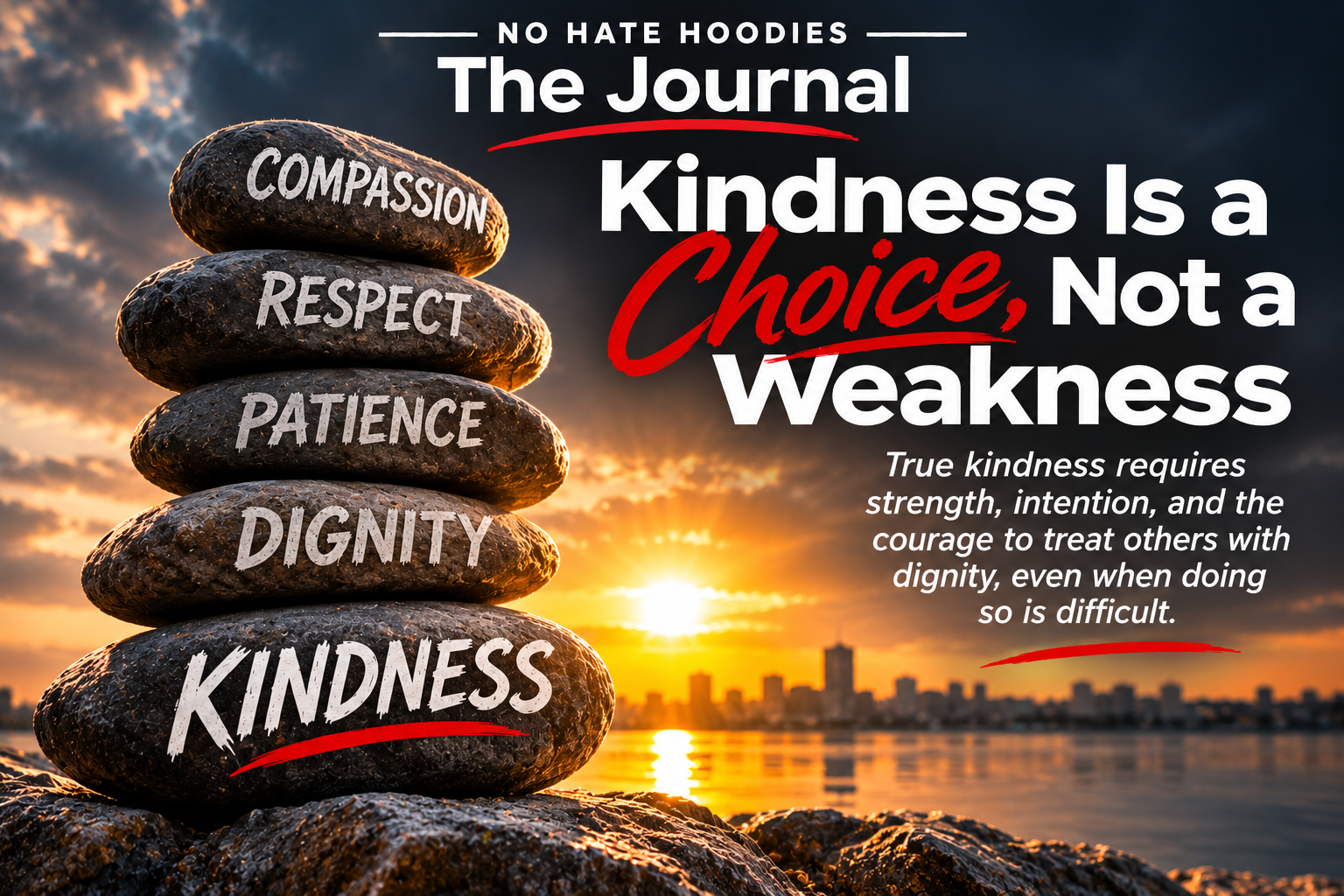
True kindness requires strength, intention, and the courage to treat others with dignity, even when doing so is difficult.
Kindness is a choice we make every day, yet we sometimes mistake it for weakness. In a world that often celebrates aggression, competition, and the ability to dominate others, kindness can appear too gentle to command respect. We may admire those who speak the loudest, respond the harshest, or refuse to compromise. Meanwhile, people who demonstrate patience, understanding, and compassion may receive less recognition for the strength their actions require.
But kindness is not the absence of strength. It is often one of its clearest expressions.
Choosing patience when frustration would be easier requires self-control. Responding with dignity when someone treats us unfairly demands emotional discipline. Offering compassion to someone whose experiences differ from our own may challenge deeply held assumptions.
None of these choices demonstrates weakness. They reveal our ability to determine how we will behave rather than allowing anger, resentment, or the conduct of others to make that decision for us.
Perhaps we need to reconsider what genuine strength looks like.
Why Kindness Is a Choice That Requires Strength
We often associate strength with confidence, independence, and determination. These qualities can help us overcome challenges and defend our convictions. Yet strength also appears in our ability to remain thoughtful under pressure and respond to difficult circumstances without unnecessary cruelty.
Anyone can react impulsively to frustration. A harsh remark may provide a moment of satisfaction, while anger can create the illusion of control. But resisting that impulse requires greater awareness and discipline.
Consider a disagreement that becomes increasingly tense. One person responds with insults, hoping to gain the upper hand. Another remains composed, communicates clearly, and refuses to turn the exchange into a personal attack.
The second person has not surrendered their position. Instead, they have demonstrated the ability to defend it without allowing hostility to determine their behavior.
Kindness is a choice that allows us to remain accountable for our actions, even when circumstances tempt us to behave differently.
Real strength is not measured solely by our ability to confront others, but also by our ability to control how we respond.
Kindness Does Not Mean Accepting Mistreatment
One of the most important misunderstandings about kindness is the belief that compassionate people must tolerate disrespect, excuse harmful behavior, or place everyone else’s needs ahead of their own.
Nothing could be further from the truth.
Genuine kindness includes respect for our own dignity. We can care about another person’s well-being while recognizing when their behavior causes harm. Setting boundaries, communicating expectations, and refusing to participate in destructive situations are not acts of cruelty.
They are expressions of self-respect.
A person can say no without being unkind. Someone may choose to end a harmful conversation without humiliating the other individual. Holding people accountable for their actions does not require denying their humanity.
Compassion and personal boundaries can exist together because kindness does not demand unlimited access to our time, energy, or emotional well-being.
In fact, the ability to establish respectful boundaries often makes genuine compassion more sustainable.
Being kind does not mean allowing others to mistreat us. It means refusing to let mistreatment determine the kind of person we become.
The Quiet Power of Everyday Kindness
Some of the most meaningful demonstrations of kindness attract little attention. They happen in ordinary moments when someone chooses to make another person’s day a little easier.
A patient response to someone who is struggling, a sincere expression of appreciation, or a willingness to listen without judgment may appear insignificant. Yet these gestures acknowledge something essential: the person receiving them deserves dignity and consideration.
Research and practical guidance from the University of California, Berkeley’s Greater Good Science Center explore how people can strengthen kindness through regular practice. Its article, Three Strategies for Bringing More Kindness into Your Life, describes ways to cultivate compassionate behavior and turn good intentions into meaningful actions.
This perspective reminds us that kindness involves more than occasional generosity. Our everyday habits influence how consistently we recognize and respond to the needs of others.
We may never know how much a thoughtful gesture matters to someone experiencing a difficult day. A few encouraging words might offer reassurance, while a moment of patience can restore a sense of dignity.
The value of kindness does not depend on public recognition or the size of the gesture.
Sometimes its greatest strength lies in the fact that we choose it without expecting anything in return.
Choosing Kindness When It Is Difficult
Kindness becomes especially meaningful when circumstances make it inconvenient.
Showing compassion to someone we admire comes naturally. Extending patience to a person who frustrates us requires greater effort. Respecting someone whose beliefs challenge our own may demand even more self-control.
These moments reveal whether kindness is simply something we appreciate or a principle we genuinely practice.
Of course, no one responds perfectly in every situation. Stress, disappointment, and emotional exhaustion can influence our behavior. We may occasionally speak too sharply, make unfair assumptions, or fail to recognize another person’s needs.
What matters is our willingness to acknowledge those mistakes and make better choices.
An apology can demonstrate responsibility rather than weakness. Changing our approach after recognizing an error requires humility. Even the decision to pause before responding to an upsetting comment reflects personal discipline.
Kindness is a choice that remains available to us, even after we have handled a situation poorly.
We cannot undo every mistake, but we can learn from our behavior and decide how we want to respond the next time.
A Stronger Understanding of Humanity
At No Hate Hoodies, we believe kindness belongs alongside dignity, compassion, courage, and respect as a principle worth defending.
Our message challenges hatred, prejudice, and cruelty, but it also asks us to consider what we choose to practice in their place.
Rejecting hate does not automatically make us compassionate. The absence of cruelty does not guarantee the presence of kindness. If we want to encourage a more humane world, our responsibility extends beyond condemning harmful behavior.
We must also demonstrate the qualities we believe deserve a greater place in society.
Our anti-hate apparel provides a visible expression of those values, but the message gains meaning through everyday action. Choosing kindness in difficult moments gives substance to the words we wear.
As we explored in The Courage to Stand Against Cruelty, standing against harmful behavior requires conviction and meaningful action. Kindness strengthens that commitment by helping us oppose cruelty without adopting it ourselves.
We can remain firm in our principles while treating others with dignity. Strong convictions need not produce hostility, and compassionate behavior does not require agreement.
Our humanity becomes more meaningful when we demonstrate those distinctions through the lives we lead.
Kindness Is Strength Put Into Practice
A kinder world will not emerge simply because people agree that kindness is important. It requires individuals willing to practice compassion when impatience, indifference, or hostility would be easier.
Everyday life gives us opportunities to make that choice.
We can respond thoughtfully during disagreements, acknowledge the efforts of people others overlook, and extend understanding to those whose circumstances differ from our own.
These actions will not eliminate every conflict or resolve every injustice. Nevertheless, they influence the relationships we build and the environments we create.
Over time, consistent choices reveal the values that guide our lives.
Kindness is a choice that requires intention, especially when we feel challenged. It does not demand perfection, passive acceptance, or the abandonment of healthy boundaries.
Instead, it asks us to recognize that our strength carries greater meaning when we use it to preserve dignity rather than diminish others.
Kindness is not weakness. Compassion is not surrender. And treating another human being with respect is never a sign that we lack strength.
Perhaps the strongest among us are not always those who speak the loudest or fight the hardest.
Sometimes they are the people who possess every reason to respond with cruelty, yet choose kindness instead.
NO HATE HOODIES
Let There Be No Hate Among Us.