

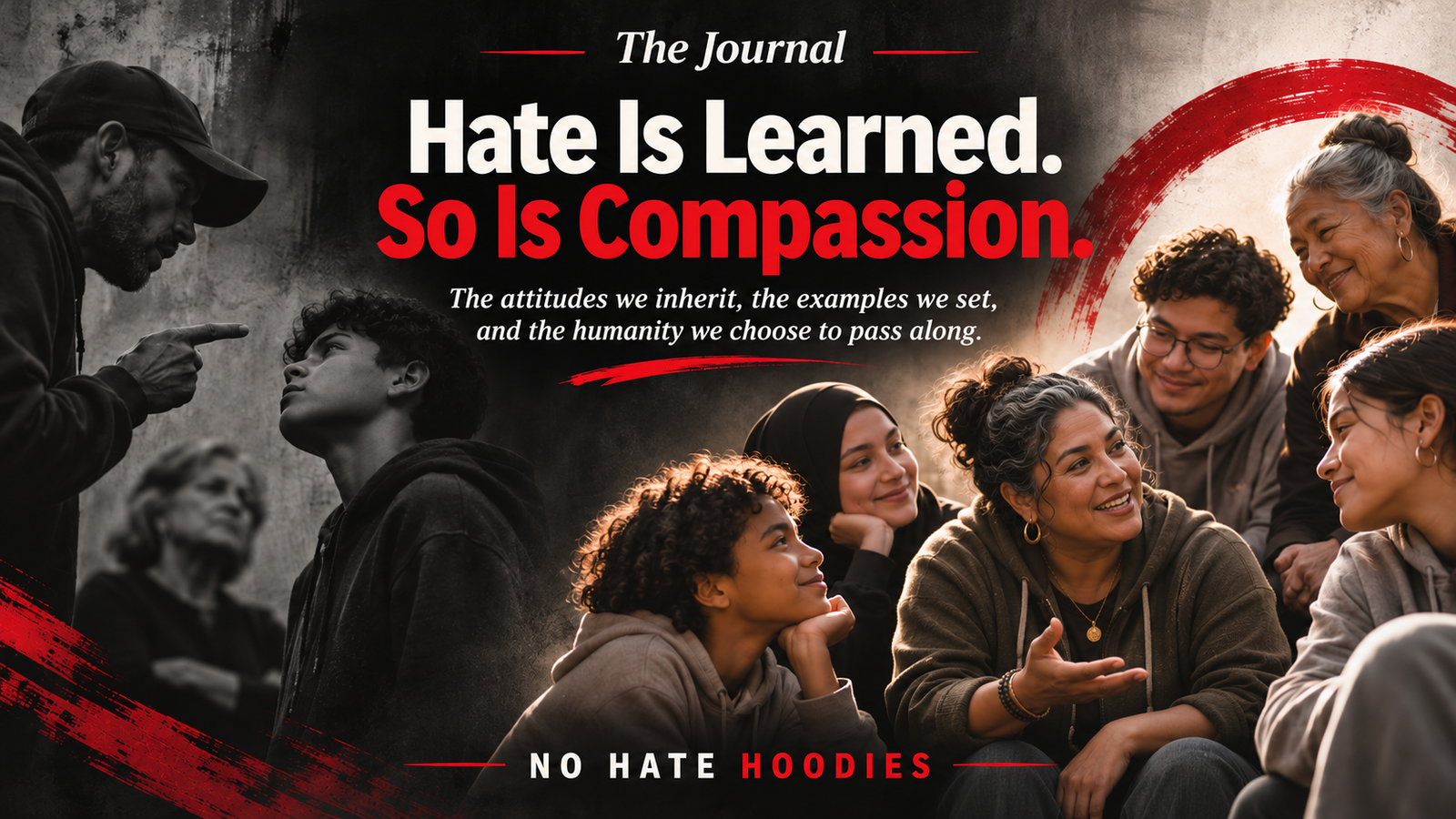
The attitudes we inherit, the examples we set, and the humanity we choose to pass along.
Every child enters a world already filled with ideas about who belongs, who seems different, and who deserves respect. Families, communities, schools, and everyday interactions influence those early impressions. A child may hear a careless remark, notice how an adult treats a stranger, or witness someone respond to an unfamiliar culture with suspicion. Over time, repeated messages can shape how we perceive others, even when no one consciously intends to teach prejudice.
Hatred has complex roots, and not every bias comes from a direct lesson. Fear, social pressure, and the desire to belong can also influence our attitudes. Still, much of what we believe about other people develops through observation, experience, and example. If our surroundings can reinforce prejudice, they can also encourage empathy, kindness, and respect.
This raises an important question. If hate is learned through the attitudes and behaviors we encounter, can we cultivate compassion through those same experiences?
The answer offers a reason for hope. The attitudes we inherit do not have to become the attitudes we pass along.
The Lessons We Teach Without Speaking
Some of the most influential lessons about human behavior never occur in a classroom. They emerge through the ordinary interactions we witness every day.
Children notice how adults speak about people who are different. They observe the respect someone extends to a stranger, the patience shown to a person who struggles, and the language others use when discussing unfamiliar cultures or beliefs. Moments of ridicule, exclusion, and hostility also leave impressions, especially when people dismiss them as harmless jokes or casual conversation.
These experiences help shape a child’s understanding of acceptable behavior. Often, the example we set carries more influence than the values we claim to hold.
A parent who speaks about kindness but routinely belittles others communicates a contradiction. Likewise, a community that celebrates equality while tolerating discrimination sends a confusing message. When our actions contradict our stated principles, we weaken the lessons we hope to teach.
The opposite holds true as well. Children who regularly witness compassion, fairness, and respect encounter living examples of those values. Through everyday interactions, they discover that differences need not create distance and that every person’s dignity deserves recognition.
The lessons that shape future generations often begin with the behavior we demonstrate today.
Breaking the Cycle of Prejudice
Many of our earliest beliefs come from the people and environments that surround us. Long before we develop the experience to question them, we absorb attitudes from families, communities, institutions, and social groups.
Not every inherited belief causes harm. Traditions, cultural identities, and shared values can provide belonging, meaning, and connection. Problems arise when assumptions about other people become so familiar that we stop questioning whether they are fair or accurate.
Breaking the cycle of prejudice requires a willingness to examine what we have learned.
We must recognize the difference between personal experience and sweeping judgments about entire groups. Questioning stereotypes, acknowledging our limitations, and considering unfamiliar perspectives can help us develop a more accurate understanding of others.
Perhaps most importantly, personal growth requires the humility to admit that we can be wrong.
Changing a deeply held attitude may challenge beliefs we have carried for years. Sometimes it requires us to reconsider assumptions shared by people we love and respect. Although that process can feel uncomfortable, it also creates opportunities for greater understanding.
We cannot control every influence that shaped our earliest beliefs. However, we can take responsibility for the attitudes and behaviors we continue to embrace.
Our past may explain how we came to see the world, but it does not have to determine how we treat others tomorrow.
Compassion Must Be Practiced
Compassion involves more than feeling sympathy when another person experiences hardship. Meaningful compassion requires attention, understanding, and a willingness to respond with kindness.
It asks us to look beyond our immediate circumstances and consider the experiences of people whose lives differ from our own. Another person’s struggles remain real even when we have never faced similar difficulties.
Developing this capacity takes practice.
Listening without immediately judging strengthens our ability to understand others. Offering patience instead of irritation demonstrates respect. A simple act of kindness can acknowledge someone’s dignity without requiring recognition or reward.
We also practice compassion when we challenge unfair assumptions, acknowledge another person’s pain, and choose words that encourage understanding rather than hostility.
These actions rarely require extraordinary circumstances. Opportunities arise during conversations with neighbors, interactions with service workers, disagreements with family members, and encounters with complete strangers.
Everyday life gives us countless chances to demonstrate the values we believe matter.
A single act of kindness cannot eliminate prejudice, but repeated choices can influence our relationships and the environments we create. Over time, compassionate behavior helps establish expectations for how people should treat one another.
Compassion becomes meaningful when it moves beyond something we admire and becomes something we practice.
What We Choose to Pass Along
Every generation inherits a world shaped by the decisions, attitudes, and actions of those who came before it. Alongside remarkable achievements and valuable traditions, we inherit divisions, prejudices, and conflicts that have persisted throughout history.
We cannot rewrite the past, but we can influence what continues into the future.
Young people deserve examples that demonstrate human worth does not depend on race, religion, wealth, appearance, or social standing. They need opportunities to see that disagreement does not require hostility and that differences do not justify exclusion.
Curiosity about unfamiliar people and experiences can replace assumptions with understanding. Respectful conversations can demonstrate that holding strong convictions does not require diminishing someone else’s humanity.
These lessons matter just as much for adults. Personal growth does not end with childhood. Throughout our lives, we can reconsider old assumptions, change harmful habits, and develop greater compassion.
Our responsibility extends beyond teaching the next generation what to believe. We must demonstrate the values we hope they will carry forward.
Living the Message of Humanity
At No Hate Hoodies, we believe opposing hatred represents only part of our shared responsibility. Equally important is choosing what we want to encourage in its place.
Our anti-hate apparel expresses a commitment to humanity, dignity, kindness, and respect. Yet the true meaning of that message comes from the choices we make and the example we set.
Wearing a statement against hate offers an opportunity to reflect on our own attitudes. Do our actions demonstrate the respect we expect from others? Are we willing to challenge prejudice when we encounter it? How often do we extend compassion to people whose experiences and beliefs differ from our own?
These questions matter because our behavior contributes to the world other people experience.
A message on clothing can encourage reflection, begin a conversation, or remind someone that kindness still matters. But the message achieves its greatest meaning when we carry those principles into our relationships, communities, and daily interactions.
What we stand for becomes most meaningful when it shapes how we live.
The Future Is Not Already Written
Hatred can become familiar when people repeatedly express, accept, or ignore it. But familiarity does not make prejudice inevitable, and history does not require us to repeat every mistake of the past.
People can question beliefs they once accepted. New experiences and relationships can strengthen empathy. Greater understanding can encourage someone to abandon harmful assumptions and choose a different way forward.
Compassion can grow through the examples we witness, the relationships we build, and the decisions we make.
No individual can control every influence that shapes society. Nevertheless, each of us can contribute something meaningful through our words, attitudes, and behavior.
We can encourage understanding rather than resentment, demonstrate respect instead of contempt, and recognize human dignity where others may overlook it.
Ultimately, the question is not simply what the world has taught us. It is what we will choose to teach through the lives we lead.
If hate is learned, compassion can be cultivated. And if prejudice can pass from one generation to the next, so can kindness, understanding, and respect.
The future of our shared humanity depends, in part, on which lessons we choose to carry forward.
NO HATE HOODIES
Let There Be No Hate Among Us.